LivePeople
LivePeople is a scalable citizen science infrastructure for personal data projects. In this documentation we focus on how to use and access the existing datasets.
Dataset examples
Examples of dataset usages
Previous studies investigated various aspects of high-quality rich datasets that include sensor data and self-reports. Some examples are (for papers based on DiversityOne, we list the sensor modalities used):
the use of social media (Giunchiglia et al. 2018)
Datasets: the authors used the SmartUnitn2 dataset, which has the same modalities and variables as DiversityOne: time diaries, application usage, screen status.
the quality of answers and mislabeling (Bontempelli et al. 2020)
Datasets: authors used SmartUnitn2 dataset, a similar dataset. The corresponding input modalities in DiversityOne are time diaries, acceleration, screen status, airplane mode, gyroscope, ring mode, battery charge, battery level, magnetic field, doze modality, headset plugged in, music playback, location, WiFi network connected to, proximity, WiFi networks available, Bluetooth, running application, notifications, atmospheric pressure (the following modalities are not available in DiversityOne: linear acceleration, gravity, rotation vector, orientation, temperature, humidity, detect incoming and outgoing calls, detect incoming and outgoing SMS).
the usefulness of self-reports towards understanding the user’s subjective perspective of the local context (Zhang et al. 2021);
Datasets: SmartUnitn2 dataset. The corresponding input modalities in DiversityOne are time diaries, acceleration, screen status, airplane mode, gyroscope, ring mode, battery charge, battery level, magnetic field, doze modality, headset plugged in, music playback, activity performed (Google Activity Recognition API), location, WiFi network connected to, proximity, WiFi networks available, Bluetooth, notifications, atmospheric pressure (the following modalities are not available in DiversityOne: linear acceleration, gravity, rotation vector, orientation, temperature, humidity).
the impact of COVID on the students’ lives (Girardini et al. 2023)
Datasets: the authors relied on SmartUnitn2 dataset and DiversityOne in Italy: time diaries.
cross-individual activity recognition (Shen et al. 2022);
mood inference (Meegahapola et al. 2023)
Datasets: for all countries: location, Bluetooth, WiFi, cellular, notifications, proximity, activity steps, screen events, user presence, touch events, app events, time diaries.
diversity perceptions in a community (Kun et al. 2022);
activity recognition (Bouton-Bessac, Meegahapola, and Gatica-Perez 2022)
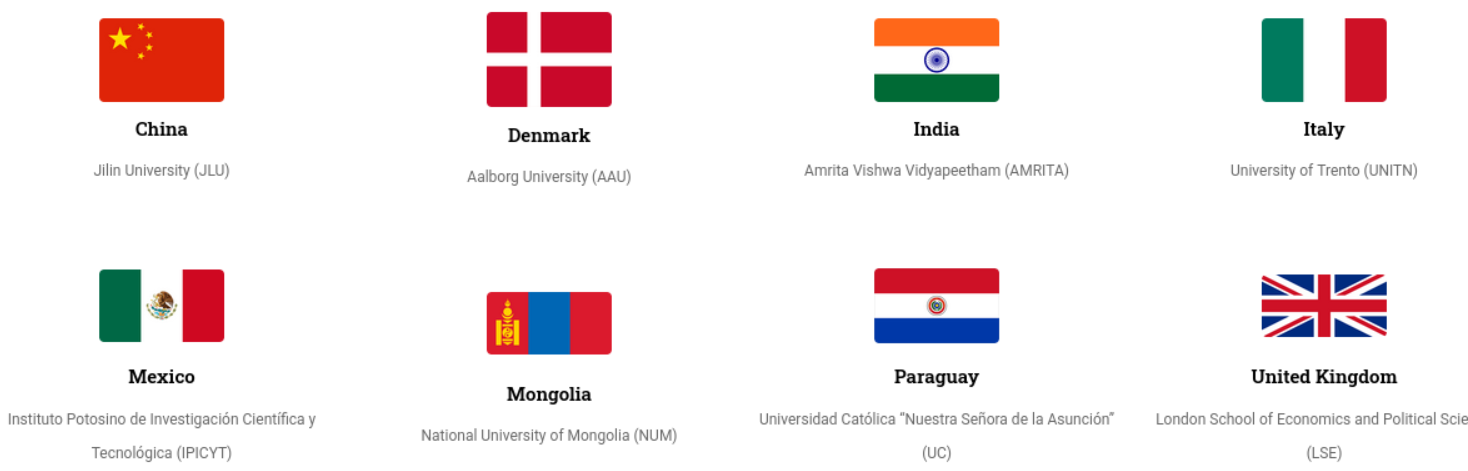
Datasets: accelerometer and time diaries data of Denmark, UK, Mongolia, Paraguay and Italy.
social context inference while eating (Kammoun, Meegahapola, and Gatica-Perez 2023)
Datasets: for all countries activity type, step count, location, phone signal, WiFi, Bluetooth, battery, and proximity, notifications, application usage, screen episodes user presence and time diaries.
inferring mood-while-eating (Bangamuarachchi et al. 2025)
Datasets: for all countries: location, Bluetooth, WiFi, cellular, notifications, proximity, activity, steps detector, step counter, screen events, user presence, touch events, app events, time diaries.
the generation of contextually rich data with other reference datasets (Giunchiglia and Li 2024).
Datasets: authors used SmartUnitn2 dataset, a similar dataset. The corresponding input modalities in DiversityOne are location and time diaries.